
Loguytren Problems: Symptoms, Causes, and Treatment

Loguytren Problems is a term people encounter when searching for answers about unusual lumps in their palms, stiff fingers, or difficulty straightening their hands. Although the name may sound unfamiliar, it usually refers to Dupuytren’s disease, a recognized medical condition affecting the connective tissue beneath the skin of the palm. What begins as a small, seemingly harmless lump can sometimes develop into a tight band that gradually pulls a finger inward. Because this process often happens slowly and causes little pain, many people overlook the early warning signs. Understanding the condition can help you recognize changes, avoid ineffective treatments, and decide when professional evaluation is worthwhile. This guide explains the symptoms, possible causes, diagnosis, available treatments, and practical ways to protect everyday hand function.
Quick Answer: Loguytren Problems generally refers to Dupuytren’s disease or Dupuytren’s contracture. The condition causes tissue beneath the palm to thicken, sometimes forming cords that pull fingers toward the hand. It commonly affects the ring and little fingers. Mild cases may only need monitoring, while more advanced contractures can require injections, needle procedures, or surgery.
What Are Loguytren Problems?
Loguytren is not an established diagnostic name in standard medical references. The medically recognized term associated with this search is Dupuytren’s disease, sometimes called palmar fibromatosis. When the condition causes a finger to remain bent and prevents normal straightening, doctors commonly describe it as Dupuytren’s contracture.
According to the American Academy of Orthopaedic Surgeons (AAOS), Dupuytren’s disease affects the palmar fascia, a layer of connective tissue located beneath the skin and above the tendons, nerves, and other important structures of the hand. AAOS
Normally, this fascia helps stabilize the skin of the palm. In Dupuytren’s disease, parts of the tissue become abnormally thick and may gradually shorten. Small nodules can appear first, followed by firm, cord-like bands.
As these cords tighten, they may pull one or more fingers toward the palm. This can make it increasingly difficult to open the hand completely.
Is Dupuytren’s Disease the Same as Dupuytren’s Contracture?
The terms are related, but they describe different stages of the same process.
Dupuytren’s disease includes the initial formation of nodules, skin dimpling, and tissue thickening. A person can have these changes without experiencing meaningful finger stiffness.
Dupuytren’s contracture refers specifically to the stage when tightened tissue restricts finger extension.
This distinction matters because not everyone with Dupuytren’s disease develops a significant contracture. Some people live for years with small, stable nodules and never require corrective treatment.
The condition is not cancer, is not contagious, and does not typically threaten overall health. However, progressive finger bending can substantially affect independence and everyday activities.

Causes and Risk Factors Behind Loguytren Problems
The exact cause of Dupuytren’s disease remains unknown. Researchers believe genetic susceptibility, changes in connective tissue, and certain health-related factors contribute to its development.
Inside the affected fascia, cells involved in tissue repair become unusually active. These cells contribute to collagen buildup and tightening of the connective tissue. The result can be thick nodules and shortened cords that interfere with finger movement.
Family History and Genetics
Heredity is one of the strongest recognized risk factors.
People with close relatives who have Dupuytren’s disease are more likely to develop it themselves. The condition is particularly associated with Northern European ancestry, although it can affect people from many ethnic backgrounds.
Having a family history does not guarantee that someone will develop the condition. Similarly, people without affected relatives can still experience it.
Age and Sex
Dupuytren’s disease becomes more common with age, particularly after 40. Men are affected more frequently than women, although women can develop the same symptoms and functional limitations.
The condition can appear earlier in adulthood, especially among people with a strong family history.
Health and Lifestyle Associations
Several factors are associated with increased risk, including diabetes, smoking, and heavy alcohol consumption. Some seizure disorders are also associated with Dupuytren’s disease.
These associations do not establish a direct cause in every patient. For example, having diabetes does not mean that hand contractures are inevitable.
The MedlinePlus medical encyclopedia, published by the U.S. National Library of Medicine, identifies family history, age, smoking, alcohol use, and diabetes among relevant factors. MedlinePlus
Does Working With Your Hands Cause It?
People who perform physical labor sometimes assume that gripping tools, typing, or repetitive hand movements caused their condition.
However, ordinary repetitive hand use has not been established as a direct cause of Dupuytren’s disease.
Symptoms may become more noticeable during demanding activities, and some cases appear or worsen following hand trauma or surgery. Nevertheless, the underlying relationship between injury and disease development is not completely understood.
People should not assume that normal hand use caused their condition.
Early Symptoms and How the Condition Progresses
Dupuytren’s disease often develops gradually. Recognizing its characteristic symptoms can help distinguish it from ordinary muscle fatigue, joint stiffness, or temporary hand discomfort.
Small Lumps Beneath the Palm
One of the earliest signs is a firm lump beneath the skin, often near the base of the ring or little finger.
The lump may initially feel tender when pressed, particularly during gripping. Over time, that tenderness often decreases.
Unlike a superficial blister, a Dupuytren’s nodule generally feels connected to deeper tissue.
Skin Dimpling and Thickened Cords
As the condition develops, the skin may become puckered or develop small indentations.
Some people notice a firm band running from the palm toward a finger. This band is commonly described as a cord.
Although the cord may resemble a tendon, it consists of abnormal fascia rather than the tendon responsible for moving the finger.
Difficulty Straightening Fingers
Progressive finger bending is the characteristic feature of contracture.
The ring and little fingers are most frequently affected, but other fingers and the thumb can also be involved. One hand or both hands may develop changes.
As tightening increases, everyday activities can become difficult. Someone might struggle to place a hand in a narrow pocket, pull on gloves, wash their face, or lay their palm flat against a surface.
The condition usually progresses over months or years. However, its course is unpredictable, and some individuals experience little change for long periods.
Is It Painful?
Dupuytren’s disease is usually painless, especially once the initial nodules have developed.
Some people experience aching, tenderness, pressure, or discomfort during particular hand movements. Significant pain, sudden swelling, redness, or warmth is less typical and warrants evaluation for another possible condition.
Dupuytren’s Disease vs. Other Hand Problems
Several conditions can create similar symptoms, but the affected structures and treatments differ.
| Condition | Typical symptoms | Main distinguishing feature |
|---|---|---|
| Dupuytren’s disease | Palm nodules, thick cords, bent fingers | Connective tissue gradually pulls fingers inward |
| Trigger finger | Clicking, catching, painful locking | Finger tendon movement becomes restricted |
| Hand arthritis | Joint pain, swelling, stiffness | Primarily affects joints |
| Ganglion cyst | Smooth lump near a joint or tendon | Fluid-filled swelling |
| Callus | Hard, thickened surface skin | Usually associated with repeated pressure or friction |
These are general distinctions rather than rules for self-diagnosis. People can experience more than one hand condition simultaneously.
How Doctors Diagnose Loguytren Problems
Doctors can usually recognize Dupuytren’s disease through a medical history and physical examination.
During the appointment, a clinician may inspect the palm, feel for nodules or cords, and measure how far each affected finger can straighten.
They may also ask when symptoms began, whether they have progressed, and whether similar problems occur in family members.
X-rays, ultrasound, or other tests are not routinely necessary when physical findings clearly indicate Dupuytren’s disease. Imaging may be useful if another condition, such as arthritis, is suspected.
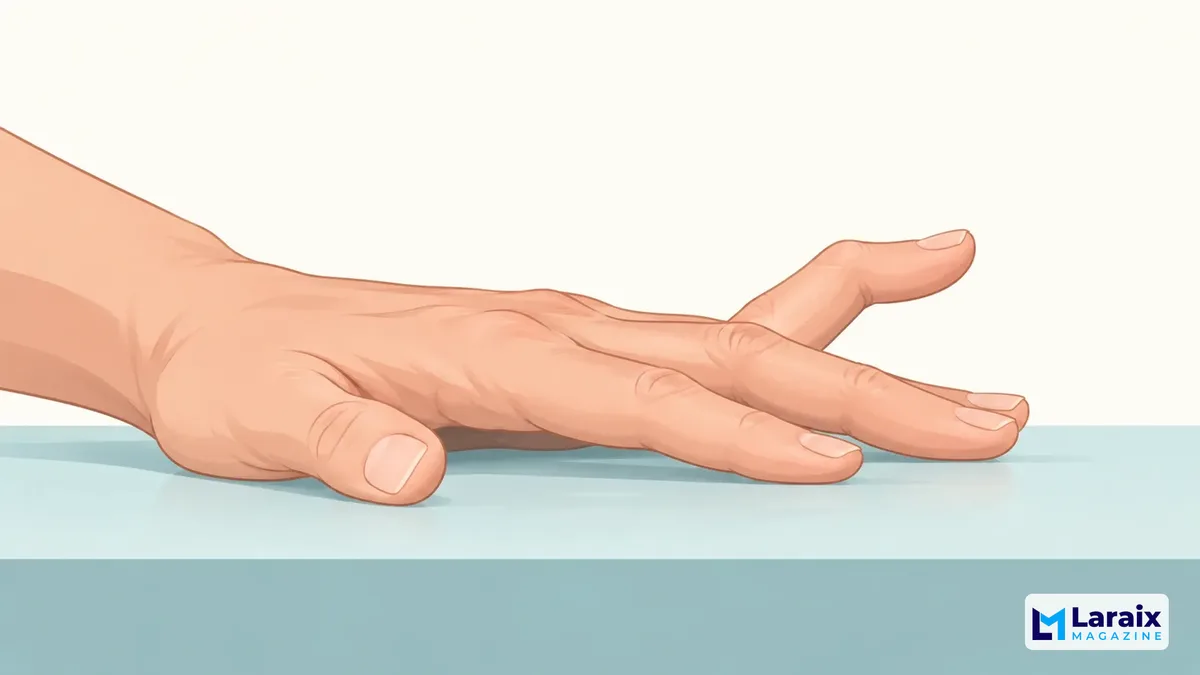
How to Perform the Tabletop Test
The tabletop test is a simple way to check whether a finger contracture is limiting hand extension. It can be useful for monitoring changes, but it cannot confirm a diagnosis by itself.
- Choose a flat surface. Sit beside a stable table or desk and relax your hand.
- Position your palm downward. Place the affected hand on the surface without forcing your fingers.
- Try to flatten your hand gently. Observe whether your palm and fingers can rest comfortably against the table.
- Check for persistent bending. Notice whether one or more fingers remain raised because they cannot straighten.
- Compare both hands. Differences may help you recognize changes, especially when symptoms develop slowly.
- Arrange an evaluation when needed. If a finger cannot straighten normally or daily activities are becoming difficult, contact a healthcare professional.
A failed tabletop test suggests that contracture may be significant enough to justify treatment assessment. However, an early Dupuytren’s nodule can be present even when the hand lies flat.
The Mayo Clinic’s diagnostic guidance, updated May 28, 2026, describes the tabletop test as a useful part of assessing finger extension. Mayo Clinic
Do not aggressively press down on a bent finger or attempt to break a cord yourself.
When Should You See a Hand Specialist?
A primary care clinician can provide an initial assessment and refer you to an orthopedic hand surgeon or another qualified hand specialist.
Professional evaluation is particularly useful when finger bending progresses, the hand no longer lies flat, or everyday tasks become harder.
Earlier assessment does not necessarily mean earlier surgery. Instead, it helps establish the diagnosis and identify appropriate treatment options before severe stiffness develops.
Treatment Options: What Works and What to Expect
Treatment depends on the severity of the contracture, which finger joints are affected, the impact on daily activities, and the person’s overall health.
There is currently no established cure for Dupuytren’s disease. Available treatments focus on relieving symptoms, improving finger extension, and restoring useful hand function.
Observation and Symptom Management
When nodules are small and hand movement remains normal, observation is often appropriate.
A healthcare professional may recommend periodic reassessment rather than immediate intervention. Some people never progress beyond this stage.
Practical adaptations, including padded tool handles and gloves, may reduce discomfort during gripping activities.
Corticosteroid injections are sometimes used for painful early nodules. They may reduce tenderness but are not proven to prevent disease progression.
Splints and aggressive stretching have not been shown to reliably stop untreated contractures. Forceful stretching may even cause injury.
Needle Aponeurotomy
Needle aponeurotomy, also called needle fasciotomy, is a minimally invasive procedure used to release a tightened cord.
After numbing the hand, the clinician uses a needle to divide or weaken the restrictive tissue. This can allow the finger to straighten more easily.
The procedure generally involves smaller wounds and shorter recovery than open surgery.
However, the condition can return, and the technique is not suitable for every cord or finger joint.
Collagenase Injections
Collagenase is an enzyme medication used to weaken certain Dupuytren’s cords.
In the United States, the FDA-approved prescription medication Xiaflex (collagenase clostridium histolyticum) is indicated for adults with Dupuytren’s contracture and a palpable cord.
A trained clinician injects the medication directly into the affected cord. At a subsequent appointment, the clinician may perform a controlled finger-extension procedure to release the weakened tissue.
Potential side effects include swelling, bruising, pain, and skin tears. Serious complications such as tendon injury or allergic reactions are possible.
The September 2026 U.S. prescribing information explains its approved use and safety precautions. DailyMed
Surgery for Advanced Contractures
Surgery may be recommended when contracture substantially interferes with normal hand function or when less invasive options are unsuitable.
A common procedure is limited fasciectomy, in which the surgeon removes affected connective tissue. Other procedures may involve releasing the fascia or removing involved skin and replacing it with a graft.
Surgery can provide meaningful improvement, but recovery is generally longer than with needle-based procedures.
Risks include infection, scarring, stiffness, nerve injury, and incomplete finger straightening. Recurrence remains possible even after successful surgery.
Comparing Available Treatments
| Treatment | Main advantages | Limitations and risks | Common situation |
|---|---|---|---|
| Observation | Avoids unnecessary procedures | Does not stop progression | Mild disease without functional problems |
| Steroid injection | May reduce painful nodule symptoms | Does not reliably prevent contracture | Tender early nodules |
| Needle aponeurotomy | Small wounds, relatively quick recovery | Higher recurrence risk; possible tissue injury | Selected contractures with accessible cords |
| Collagenase injection | Nonsurgical cord release | Swelling, bruising, recurrence, rare serious injury | Suitable contractures with palpable cords |
| Fasciectomy | Often provides longer-lasting correction | Longer recovery and surgical complications | More substantial functional limitations |
A 2024 systematic review comparing needle fasciotomy, collagenase injections, and limited fasciectomy found that the treatments could achieve similar longer-term contracture reduction, but fasciectomy generally offered more durable results while carrying greater risk of serious adverse events. PubMed
Radiation therapy has also been studied for early-stage disease. However, uncertainties about its effectiveness and long-term outcomes mean that it should not be viewed as an established routine solution for every patient.
No single treatment is best for everyone. A hand specialist can explain which options fit the specific joints involved and the patient’s priorities.
Living With Dupuytren’s Disease: Practical Everyday Steps
Managing Dupuytren’s disease involves more than choosing a procedure. For people with mild symptoms, maintaining comfort and recognizing changes may be the most useful immediate goals.
Make Daily Activities More Comfortable
Small adjustments can reduce the inconvenience associated with limited finger extension.
For example, wider handles on kitchen utensils, gardening equipment, or frequently used tools may be easier to grip. Padded gloves may help when pressure on palm nodules causes discomfort.
People who have difficulty using particular objects can ask an occupational therapist or certified hand therapist about adaptations tailored to their activities.
These changes cannot reverse the underlying tissue thickening, but they may help preserve independence.
Monitor Changes Without Obsessing Over Them
Pay attention to meaningful changes in finger extension and daily function.
You may find it useful to record when a new nodule appears, when an existing cord becomes more noticeable, or when a previously manageable activity becomes difficult.
Occasional photographs taken under similar conditions can help communicate changes to a clinician.
A simple record of symptoms is often more useful than repeatedly testing or stretching the hand throughout the day.
Protect Your General Health
Stopping smoking, limiting excessive alcohol consumption, and managing diabetes are worthwhile for overall health.
However, there is no convincing evidence that these measures alone will reverse established Dupuytren’s cords.
Similarly, supplements, massage devices, creams, and online exercise programs should not be assumed to dissolve abnormal fascia simply because they advertise improved flexibility.
Before spending money on a product claiming to cure Dupuytren’s disease, look for credible clinical evidence supporting that specific claim.
Understand Recovery and Recurrence
Recovery depends on the treatment performed.
Needle procedures generally have shorter recovery periods, while open surgery may require several weeks of wound care, gradual movement, and rehabilitation.
Some patients need hand therapy or prescribed splinting following treatment. The instructions differ according to the procedure and the clinician’s recovery plan.
Importantly, successful treatment does not permanently eliminate the underlying disease process.
A finger can become bent again, and additional nodules or cords may eventually develop. Follow-up is therefore valuable when new symptoms or functional difficulties appear.
Frequently Asked Questions
1. Are Loguytren Problems a recognized medical condition?
Loguytren is not the standard medical name. The term generally refers to Dupuytren’s disease or Dupuytren’s contracture, which causes abnormal thickening of connective tissue in the palm.
2. What is usually the first sign of Dupuytren’s disease?
The first noticeable sign is often a small, firm lump beneath the skin of the palm. Skin dimpling may also develop before any significant finger bending occurs.
3. Can Loguytren Problems affect both hands?
Yes. Dupuytren’s disease can affect either hand or both hands. The severity and speed of progression may differ between them.
4. Can Dupuytren’s contracture disappear without treatment?
Some early nodules remain stable for years, and not everyone develops a contracture. However, established finger contractures generally do not resolve completely on their own.
5. Can hand exercises cure Dupuytren’s disease?
No exercise has been proven to eliminate Dupuytren’s cords. Gentle movement may support comfort and mobility, particularly during prescribed rehabilitation, but forceful stretching should be avoided.
6. Is surgery always necessary for Dupuytren’s contracture?
No. Many people with mild disease need only observation. Needle procedures, collagenase injections, and surgery are considered according to contracture severity and functional limitations.
7. Can Dupuytren’s disease return after treatment?
Yes. Recurrence is possible following injections, needle release, or surgery because these treatments do not eliminate the underlying tendency for abnormal tissue formation. The likelihood varies with the treatment method, disease severity, and individual characteristics.
Conclusion
Loguytren Problems is best understood as a search term generally referring to Dupuytren’s disease, a condition that causes connective tissue in the palm to thicken and sometimes pull fingers into a bent position. Although the condition is usually painless and progresses slowly, it can eventually make ordinary activities difficult.
The encouraging news is that many people never need invasive treatment, and several established medical options can improve hand function when contractures become troublesome. Understanding the difference between early nodules and significant finger contracture helps people make better-informed decisions.
If you notice persistent palm lumps, developing cords, or difficulty straightening a finger, arrange an examination with a healthcare professional. An accurate diagnosis and an individualized management plan are more useful than relying on unproven home remedies or waiting until hand function becomes severely restricted.